The 3 Levels of Microtonal
What follows expands each of those three layers in turn. They are not rivals so much as different vantage points on the same observation: 12-EDO is one tuning grid among many, and music keeps slipping off it — sometimes by accident, sometimes by tradition, sometimes by manifesto.
Through Bends & Vocals in 12-EDO
Microtonal bends and vocals — pitches falling between the standard 12 notes of 12-TET — are everywhere in blues, rock, soul and a good chunk of pop. They function as expressive blue notes, as “notes between the notes” that create tension, ache and a sense of vocal shape even on instruments that nominally can't bend at all.
Vocal examples
- Jacob Collier — In the Bleak Midwinter: ten tracks of himself singing in what he calls “G half-sharp major,” precise microtonal harmonies producing a shimmering choral colour that 12-EDO simply cannot reach.
- Spoon — Do You: the intro features a hummed melody using microtonal steps to create an uneasy, off-kilter hook.
- Paul Simon — Insomniac's Lullaby (from Stranger to Stranger, 2016): instruments tuned to different systems produce notes outside the standard Western scale.
- Led Zeppelin — Black Dog live with Egyptian musicians: Robert Plant adapts his vocals to 24-TET (quarter-tone) Arabic maqams.
Instrumental bends
- Blues guitar (John Lee Hooker, B.B. King): the 3rd and 7th are bent slightly sharp, landing in the space between minor and major — the foundational microtonal move of Western popular music.
- King Gizzard & The Lizard Wizard — Flying Microtonal Banana: custom-fretted guitars in 24-TET, allowing consistent microtonal riffs that aren't bends but intentional, locked-in notes.
- Country pedal-steel: microtonal bends are used to mimic vocal nuance — the famous “crying” effect comes from hovering between tones rather than landing on them.
- Clapton, Albert King: small expressive bends on the minor pentatonic — especially around the flat 3 and the 4 — give the melodic line its “slide.”
Key techniques
- Blue notes: usually 3rds, 5ths and 7ths lowered — sometimes by an actual quarter-tone — producing a bent, wavering pitch.
- Slide / slip guitar: continuous pitch motion between frets, often resting on a note that isn't on any fret at all.
- Synth pitch-bend: from Hancock's Rockit onwards, warping pitch away from standard tuning has been a core gesture of modern production.
- Exaggerated vibrato & ornaments: singers and string players push vibrato wide enough that it borders on an audible microtonal shift — an emotional, not a theoretical, microtonality.
The point of Level 1 is that most Western listeners are already steeped in microtonal sound without naming it. The ear hears it; the theory doesn't.
Happening Worldwide, Historically
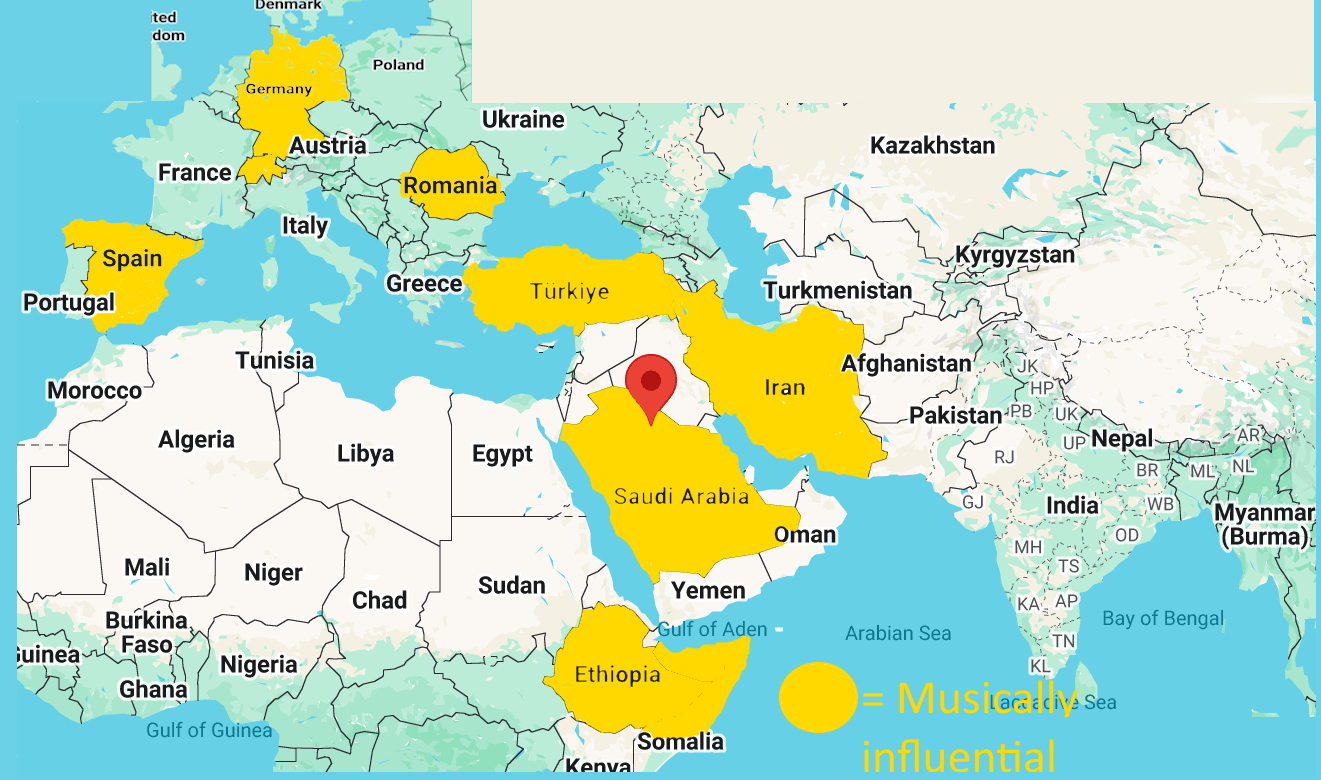
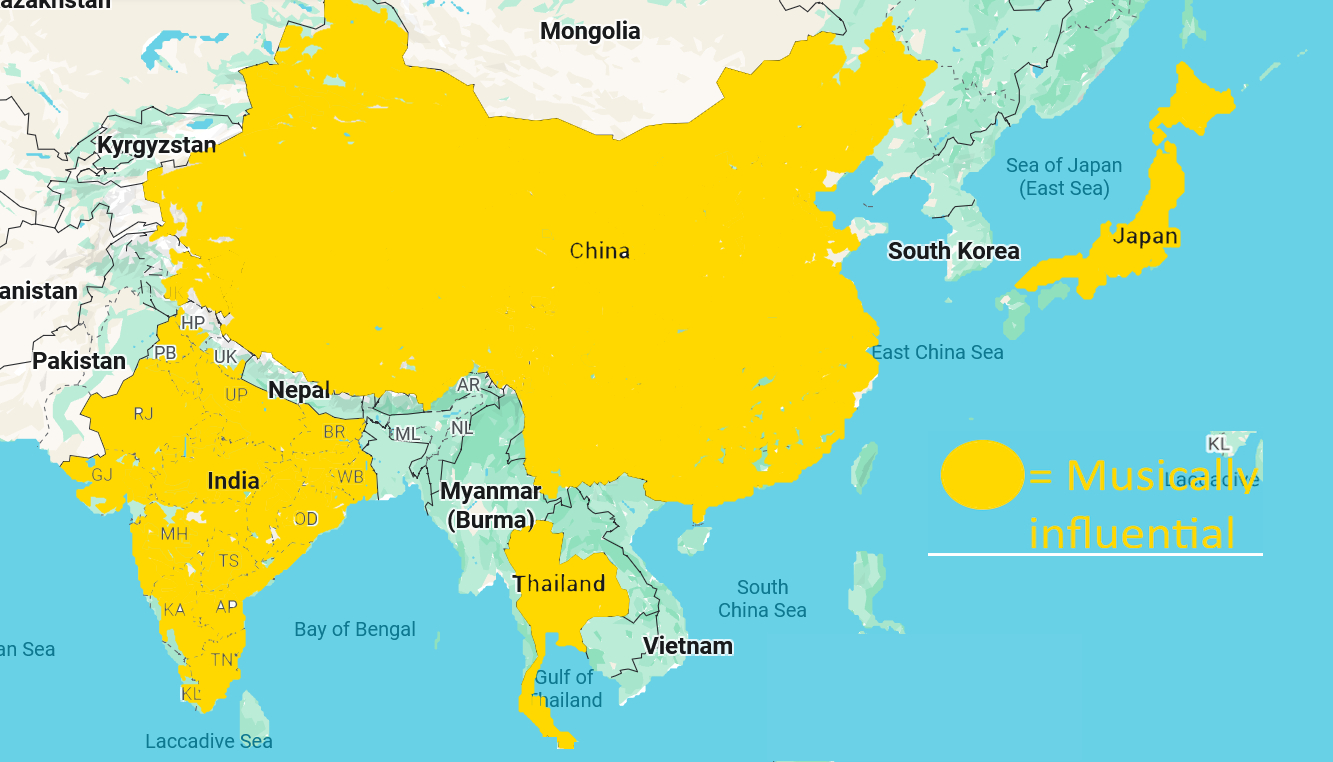
Outside the West, non-12-EDO systems are not experiments — they are the everyday musical grammar of entire civilisations, and most of them are still in active practice today. The West is the unusual case, not the default.
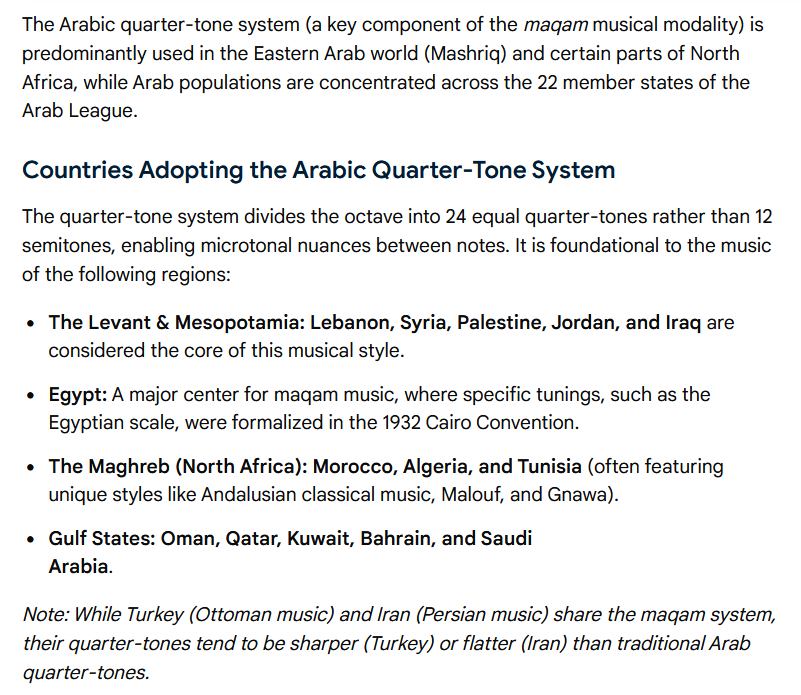
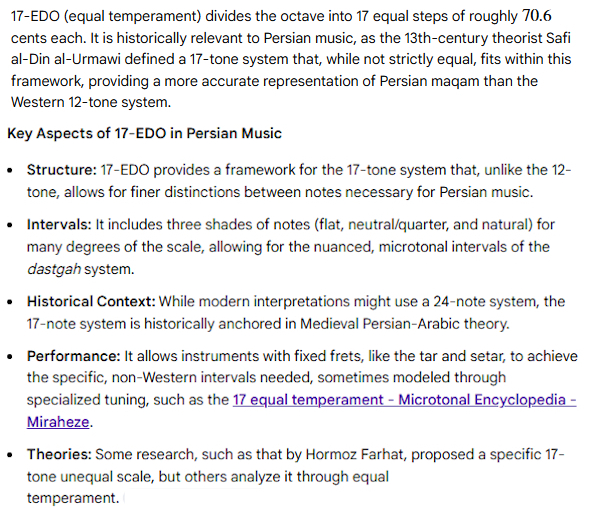
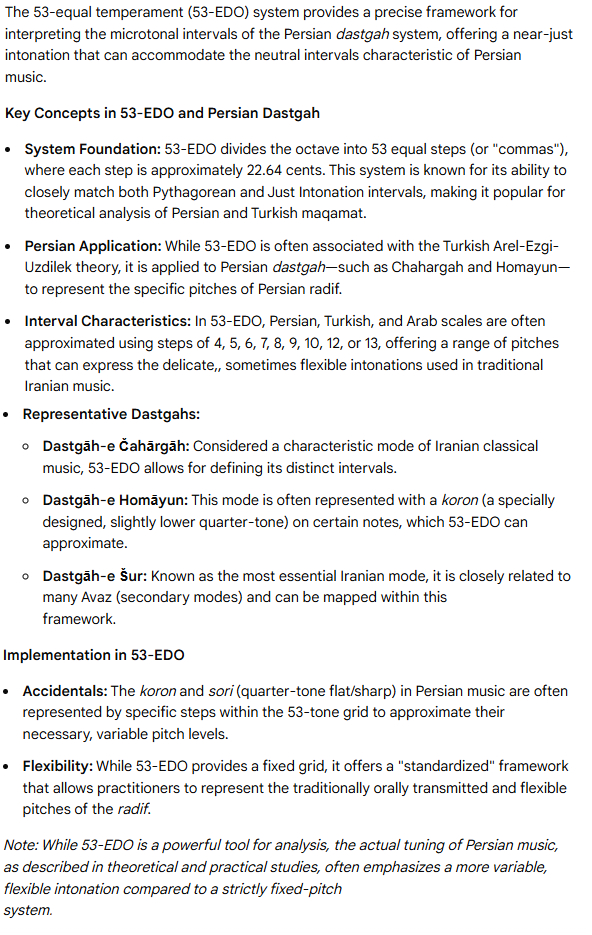
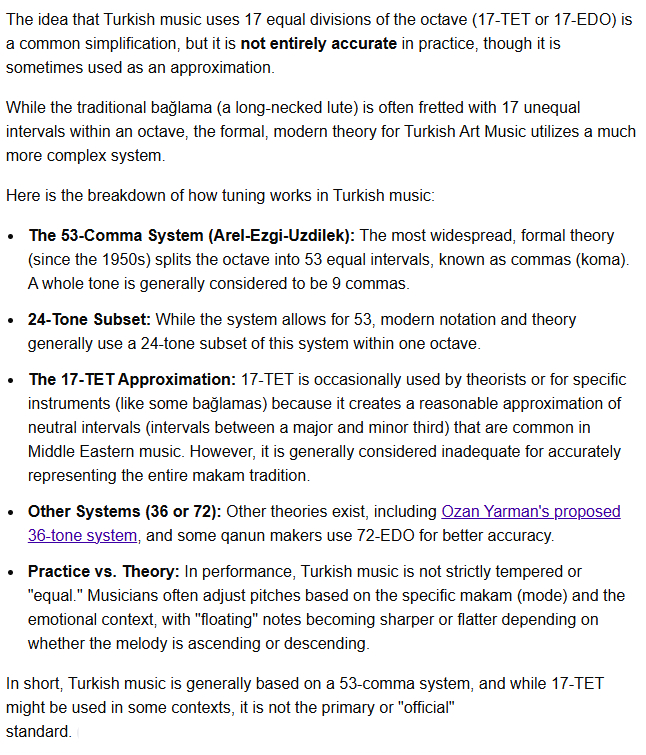
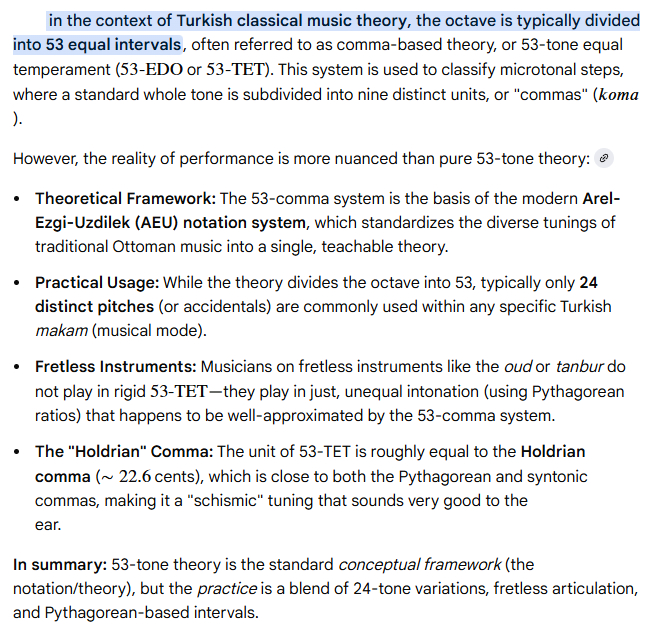
Most Turkish makams in 53-EDO use steps of 4, 9 and 13 (m2, M2, m3), which sit within roughly 12¢ of the JI versions of their 12-EDO equivalents — a tuning whose “exotic” flavour is in fact closer to just intonation than 12-EDO is. Persian Dastgah shows much more diversity and distance from 12-EDO, with scale steps of 5, 6 or 7 in 53-EDO. Middle-Eastern traditions as a whole work with quarter-tones, 53-EDO and historically JI versions of 17-EDO. The Indian system is arguably the most in-tune of all, deviating only by a syntonic comma (81/80) from the nearest 5-limit JI ratios for roughly half its notes.
Zooming in on India — Hindustani vs. Carnatic
Indian classical music, comprising the Hindustani (North) and Carnatic (South) traditions, uses 12-note chromatic scales with a movable tonic (sliding octave) rather than a fixed pitch, and most often employs just intonation (JI) principles rather than equal temperament. Hindustani music focuses on slow melodic improvisation built on 10 thaats; Carnatic music is more structured, with 72 melakarta parent scales, a heavy emphasis on composition, and faster gamakas.
Key aspects of Indian music theory
- 12-Note system: both traditions technically use 12 notes in practice, despite the deeper theoretical discussion of 22 śruti (microtones).
- Just intonation: Indian music relies on pure, consonant intervals rather than the harmonically-adjusted intervals of Western equal temperament.
- Tonic flexibility: the tonic (Sa) is relative, not absolute — it moves to fit the vocalist or lead instrument.
Carnatic vs. Hindustani musicology
- Raga structure:
- Hindustani (North) — classified into 10 thaats (fundamental scales). The focus is on ālāp (improvisation) and the slow, emotional unfolding of the raga.
- Carnatic (South) — uses the melakarta system, identifying 72 parent scales, which enables a highly technical, formulaic classification.
- Ornamentation (gamakas):
- Hindustani: slower, flowing glides (meend).
- Carnatic: faster, more intense oscillations and intricate ornamentation, often described as more “grand” in its structural application.
- Rhythm and structure:
- Hindustani: often emphasises a slower build-up (vilambit) towards faster, improvised sections, with 12 main tāla (rhythmic) structures.
- Carnatic: known for rigorous rhythmic structure (7 core tāla) and a high reliance on composed, fixed pieces (kritis).
- Influences: Hindustani music carries strong Persian influence, while Carnatic stays closer to traditional Vedic and temple-music practice.
Theoretical underpinnings
- Melakartas (Carnatic): a 72-scale system categorising ragas by the notes they use.
- Thaats (Hindustani): a simpler 10-scale classification.
Key differences in a nutshell
- Approach: Hindustani is improvisation-heavy; Carnatic is composition-based.
- Role of accompanists: much more central in Carnatic concerts, where the violin is a true partner to the lead, unlike the more passive role of the sarangi or harmonium in Hindustani settings.
Zooming in on China — Zhu Zaiyu and the invention of 12-EDO
Chinese musicology is where Level 2 takes an unexpected twist: the 12-tone equal-temperament system itself — the very grid that Level 3 reacts against — was first solved mathematically not in Europe but in Ming-dynasty China, by the prince-scholar Zhu Zaiyu (1536–1611). He is generally credited as the first person to compute and apply equal temperament, a discovery that preceded the analogous European work by decades.
Historical context and development
- The tuning problem: historically, Chinese music — like early Western music — was based on Pythagorean tuning (the Shí-èr lǜ in its earlier form), using 3:2 ratios. This works for a single key but causes severe dissonance when modulating, because notes don't line up after changing scales.
- Zhu Zaiyu's discovery (1584): he resolved the problem by dividing the octave into 12 equally-proportioned semitones, working out the 12th root of 2 through a careful geometric progression and so ensuring that each adjacent semitone ratio is identical — enabling seamless transposition across all 12 keys.
- Instruments: to prove the theory in practice, Zhu Zaiyu designed and built new instruments, including bamboo pipes calibrated to his 12-EDO system.
Relationship with traditional Chinese musicology
- Shí-èr lǜ (Twelve Pitches): while 12-EDO is the modern standard, traditional Chinese music is built on the Shí-èr lǜ, a set of twelve fundamental pitches.
- Difference in application: 12-EDO splits the octave into 12 mathematically equal steps; the traditional Shí-èr lǜ was used to construct specific scales rather than as a tempered chromatic ground for harmonic modulation.
- Extra-musical associations: the twelve pitches were deeply tied to cosmology — the 12 months, the 12 hours of the day, and yin–yang principles.
- Persistence of other tunings: despite the early invention of 12-EDO, traditional string instruments like the guqin continued to use more justly-intoned tuning methods for the bulk of the traditional repertoire.
Modern relevance
- Modern Chinese music: modern Chinese music — especially orchestral writing — is heavily 12-EDO, which makes the blending of traditional Chinese instruments with Western ones practical.
- 12-Lü vs. 12-EDO comparisons: musicological studies often contrast the Chinese 12-Lü with Western 12-EDO. 12-EDO allows free modulation, whereas the traditional Shí-èr lǜ is designed around a central fundamental tone.
- 12-tone composition arrives late: although 12-EDO as a tuning was invented in 16th-century China, the 12-tone technique as a compositional method (dodecaphony) only reached China in the 1940s, and the first home-grown 12-tone pieces only appeared in the late 1970s.
- Pentatonic mapping: modern studies routinely map Chinese pentatonic scales onto a 12-EDO grid in order to analyse their shared characteristics with Western tonal music.
So China occupies a peculiar position in this taxonomy: it produced 12-EDO ahead of the West, then largely didn't adopt it as everyday performance practice for centuries — another reminder that having the theory and living inside it are two different things.
Zooming in on Japan — microtones as expressive grammar
Traditional Japanese music uses microtones constantly — not as experiment, but as intentional pitch inflections, subtle ornamentations and instrument-specific tuning systems. These intervals, often sitting between the semitones of a Western piano, are integral to the melodic and emotional grammar of the music. The point isn't to sound “outside” the system; the system is microtonal to begin with.
Key aspects of microtonality in Japanese musicology
- Technique-driven pitch-bending: instruments produce microtonal variation through specific performance techniques. On the shakuhachi, nayashi (a controlled downward/upward head movement) and muraiki (a sharp breath attack) lower a note by roughly half a tone to create a gliding or “shading” effect.
- Instrumental tuning systems: traditional instruments — especially the 13-string koto — often use Pythagorean-based tunings such as Hirajoshi that diverge meaningfully from 12-EDO.
- Ornamentation and timbre: microtones are heavily used in gagaku (imperial court music) and in traditional ensemble music, where instruments like the hichiriki and the transverse flute use elaborate microtonal ornamentation to enrich the melodic line.
- Nuclear-tone theory: musicologists — notably Fumio Koizumi — analysed Japanese music not through Western scales but through “nuclear tones”: microtonally inflected core notes around which the melody orbits.
- Contrasting temperaments: Japanese traditional music carries its own unique tuning systems, but some research detects a distinctly Pythagorean character in the Japanese semitone, echoing the 3-limit lineage rather than the 5-limit Western consonant world.
The Japanese case is a particularly clean example of Level 2: microtonality here is neither a quirk of expression (Level 1) nor a deliberate revolt against a dominant grid (Level 3) — it’s simply how the music is, encoded into the instruments themselves.
Zooming in on Ethiopia — the Qenet modes
Ethiopian musicology is rooted in a unique modal system known as Qenet (or Kignit), which routinely uses microtonal intervals outside Western 12-EDO. Unlike Arabic music, these microtones aren’t organised into strict quarter-tones — they appear as neutral intervals, melodic inflections and small pitch variations that give Ethiopian music its characteristic haunting quality.
Core principles of Ethiopian microtonality
- Melodic inflection: microtonal variation lives in linear, melodic phrasing — not in a vertical, harmonic system.
- The Qenet system:
four primary modes, each with its own microtonal flavour, used throughout the music of the Ethiopian Highlands:
- Tezeta — a “minor”-feeling mode with a distinctive flat 3rd and flat 5th (its Half Tizita variant).
- Bati — two main forms: a major form with a neutral 2nd, and a minor form using a flat 2nd and flat 5th.
- Ambassel — a pentatonic mode (roughly 1, ♭3, 4, 5, ♭7 in shorthand).
- Anchihoye (version 2) — built around a minor 2nd, perfect 4th, diminished 5th and augmented 6th.
- Tuning systems: rather than equal temperament, traditional Ethiopian instruments use pure or customised tunings, which can make octaves feel slightly stretched or compressed against a piano reference.
Instruments and performance
- Masinqo (one-stringed fiddle) — the primary vehicle for these microtones; the player slides continuously between notes to land on the precise, non-tempered pitch a phrase calls for.
- Krar (lyre) — used to play these modes, with tuning adjusted to emphasise specific intervals of the chosen Qenet.
- Vocal technique: singers use micro-inflections, vibratos and “scoops” that don’t align with any equal-tempered grid.
Key concepts in Ethiopian musicology
- Heterophony: ensemble instruments play subtly different versions of the same melody simultaneously, producing a dense, microtonally-rich texture rather than strict harmony.
- Oral tradition: tuning practices are passed down through generations, with substantial regional variation as a consequence.
- Academic study: researchers like Cynthia Tse Kimberlin have mapped the Qenet system in cents — e.g. her work Masinqo and the Nature of Qenat — turning the oral tradition into measurable interval data.
Ethiopia is a useful Level 2 case precisely because its microtones don’t snap to a grid: there is no “Ethiopian EDO” in the way one might point to 53-EDO for Turkish makam. The intervals are real and consistent, but they’re defined by tradition and ear rather than by a tempered division of the octave.
A caveat the original notes are honest about: how rigidly any given culture “really” tunes to its theoretic framework is itself a moving target. The figures above are the theoretical grids; live practice in any of these traditions involves micro-inflections that no EDO can quite pin down — which is precisely the point of Level 1 too.
Reactionary Westerners
The third level is the explicitly experimental one — the modern Western desire to stray from the hegemony of 12-EDO. It tends to be the most theoretically self-conscious of the three, and often the most stridently “microtonal” in its branding, even though it is in fact the youngest and least everyday of the three layers.
12-EDO is, in honest cents-from-JI terms, about as off as most non-Western systems are — sometimes more — yet it carries a cultural superiority complex that doesn't really reflect its tuning merits. A lot of listeners simply don't notice Level 1 happening in the music they already love, and grow up believing that 12-EDO is the natural ground state of music. Level 3 is, in part, a reaction to that belief.
Generalities
- Ancient Greek music: the “enharmonic genus” involved intervals smaller than a semitone, so the impulse is not new even within the Western lineage.
- Non-Western influence: by the late 19th and early 20th century, exposure to non-Western music — e.g. the Javanese gamelan at the 1889 Paris Exposition — spurred Western interest in alternative tunings.
- Terminology: the word “microtone” itself was coined by Maud Mann in 1911 to describe sub-semitone intervals in Indian music.
Quarter-tones — the first Western publications
The first Westerner to publish a composition using quarter-tones was the German composer Richard Heinrich Stein (1882–1942), whose Zwei Konzertstücke für Violoncello und Klavier appeared in 1906. Earlier experiments existed — Guillaume Costeley played with microtonal systems as early as 1558, and 19th-century theorists had proposed various schemes — but modern Western microtonal music as a self-aware movement really begins in the early 20th century.
Key 20th-century figures
- Richard Heinrich Stein (1906) — first published quarter-tone works.
- Willi von Möllendorf (1917) — quarter-tone compositions and theoretical texts.
- Charles Ives (early 20th c., culminating in the Three Quarter-Tone Pieces for Two Pianos, 1923–24) — independent American development of quarter-tones.
- Alois Hába (b. 1893, started in 1918) — Czech composer, the leading and most influential figure of quarter-tone and sixth-tone systems.
- Ivan Wyschnegradsky (1893–1979) — Russian-French composer; built a comprehensive theory of pansonority and composed for specially tuned pianos.
- Julián Carrillo (1875–1965) — Mexican composer of Sonido 13, exploring 16th-, 32nd- and smaller divisions of the tone, with custom-built guitars and pianos.
Earlier outliers worth flagging
- Nicola Vicentino (1550s) — built the archicembalo, a Renaissance keyboard capable of playing microtonal intervals.
- Charles Delusse (1760) — French flautist; published Air à la grecque, incorporating quarter-tones to emulate ancient Greek music.
The Level-3 tradition is often more experimental than Levels 1 and 2 combined — partly because it doesn't have centuries of practical performance tradition to keep it in check, and partly because that's the entire point: it exists to deliberately push past what the surrounding culture takes for granted.
Three layers, one observation: the ear is microtonal long before the theory catches up — and every culture, including ours, decides for itself which slivers of pitch to canonise and which to call “out of tune.”